review · Printers
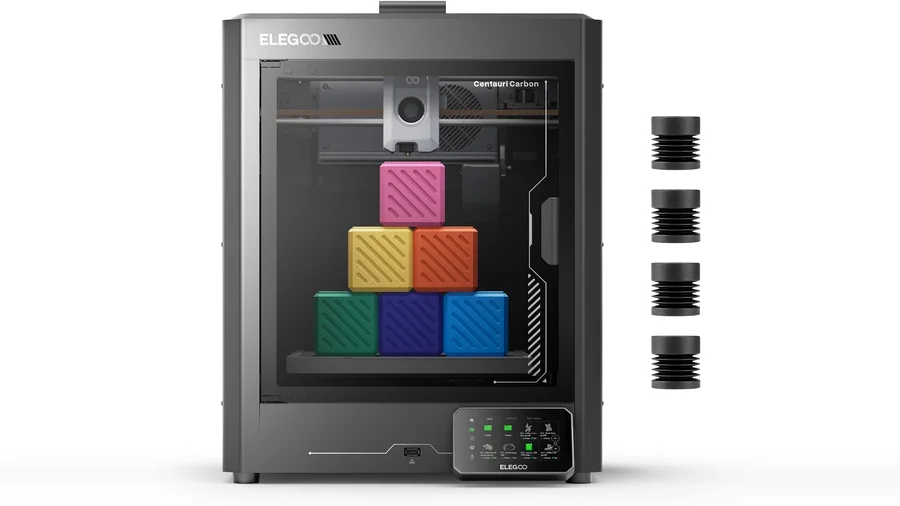
Elegoo Centauri Carbon Review: The $299 Enclosed CoreXY Champ
By Leo · Updated 2026-09-06
Is the Elegoo Centauri Carbon worth buying?
At $299, the Centauri Carbon is the strongest value in enclosed 3D printing right now: a fully enclosed CoreXY printing at 500 mm/s with auto calibration, for $100 less than Bambu’s enclosed P1S. The compromises are ecosystem, not hardware — fewer community profiles, a younger parts and accessories market, and polish that’s a generation behind Bambu’s firmware. For a second printer, a workshop machine, or anyone printing ABS/PETG-adjacent materials on a budget, it’s the default pick. This review synthesizes manufacturer specs and consistently reported community experience — our own protocol test hasn’t run on it yet.
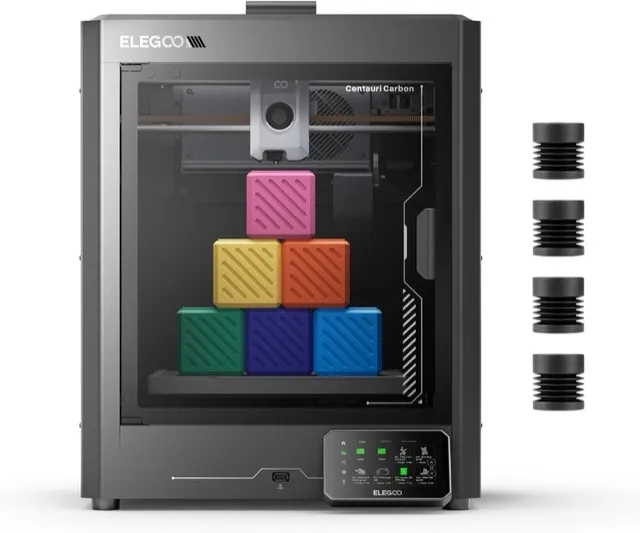
Elegoo
Elegoo Centauri Carbon
- build volume
- 256 × 256 × 256 mm
- max speed
- 500 mm/s
- enclosure
- Yes
What you get at $299
- Enclosed CoreXY architecture — the same class of machine Bambu charges $399 for. The chamber matters for PETG consistency and makes ABS/ASA practical, which open-frame budget machines can’t touch.
- 500 mm/s rated speed (with 20,000 mm/s²-class acceleration) — the modern fast-printing baseline, and per every comparison we’ve seen it holds its own against the P1S in real prints.
- 256 × 256 × 256 mm build volume — matching Bambu’s flagship cube exactly.
- Auto-calibration — leveling, vibration compensation, and flow calibration run automatically. Out-of-box success stories dominate community reports (r/3Dprinting’s budget threads treat it as the consensus sub-$300 pick, and CNET/All3DP’s budget coverage agrees).
The honest compromises
- Ecosystem depth. Bambu’s profile library, parts availability, and community troubleshooting depth are a generation ahead. When a Centauri Carbon prints badly, you’re more often your own support engineer.
- Firmware polish. Community reports describe a competent but less refined software experience — fewer niceties, rougher edges, faster iteration from Elegoo to fix them.
- The CC2 exists. Elegoo’s own Centauri Carbon 2 (~$349, 350 °C hotend, Combo multicolor at $449) sits $50 up with a newer everything. The original at $299 is the value play; the CC2 is the “buy once” play.
Side by side: the enclosed-CoreXY field
| Product | Rating | Build Volume | Max Speed | Enclosure | Buy |
|---|---|---|---|---|---|
| Elegoo Centauri Carbon | 4.4 (community est.) | 256 × 256 × 256 mm | 500 mm/s | Yes | View |
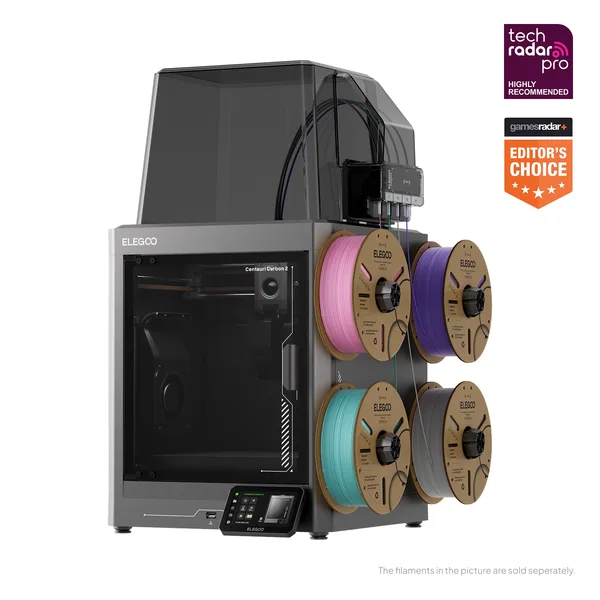 Elegoo Centauri Carbon 2 | — | 256 × 256 × 256 mm | 500 mm/s | Yes | View |
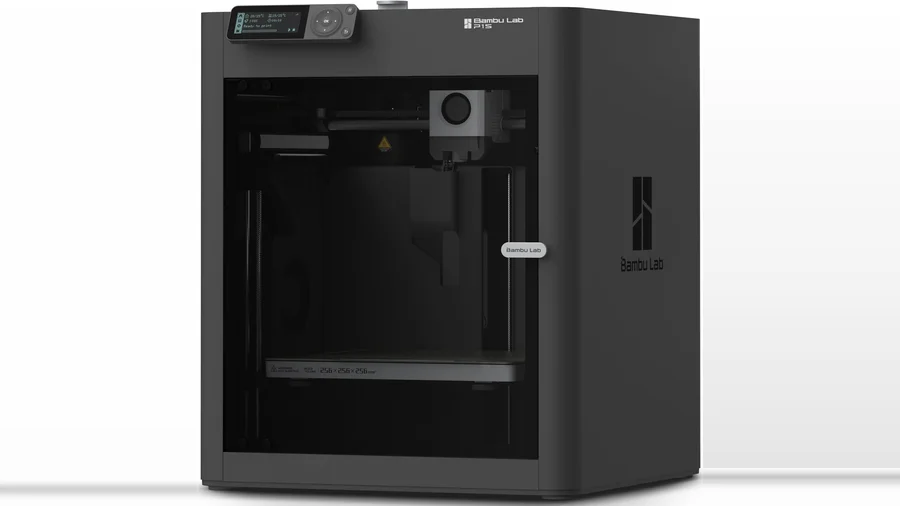
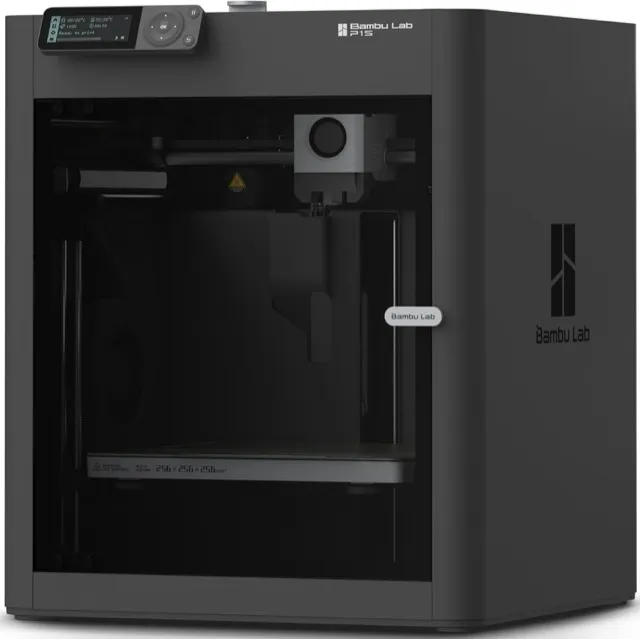 Bambu Lab P1S | 4.6 (community est.) | 256 × 256 × 256 mm | 600 mm/s | Yes | View |
Full trade-offs in our P1S vs Centauri Carbon comparison. Short version: the P1S’s premium buys Bambu’s ecosystem and multi-material path (AMS), not print quality.
Who should buy it
- Budget-first buyers who want enclosure — nothing else enclosed and fast comes close at $299
- Second-machine buyers — as a dedicated ABS/PETG workhorse next to any open-frame printer
- Skip if multicolor from day one is the goal (CC2 Combo or Bambu’s AMS path fit better), or if you want the deepest possible community safety net — then the Bambu A1/P1S line earns its premium
FAQ
Is the Elegoo Centauri Carbon better than the Bambu Lab P1S?
At $100 less, it matches the P1S on architecture, speed class, and build volume. The P1S's advantage is ecosystem: more community profiles, better parts availability, and the AMS multicolor path. If budget leads, the Centauri Carbon wins; if ecosystem leads, the P1S does.
Should I buy the Centauri Carbon or the Centauri Carbon 2?
The original at $299 is the value pick — same core architecture for $50 less. The CC2 adds a 350 °C hotend, refinements, and an optional multicolor Combo at $449, which makes it the better long-term single purchase.
Can the Centauri Carbon print ABS?
Yes — the enclosed chamber is the point. Community reports describe successful ABS/ASA printing, with the usual ventilation caveats that apply to any FDM printer running those materials.